When I told people I was starting an MSc in Psychology at sixty, they said things like ‘go you’, but deep down most of them thought I’d lost the plot. The awkward part was that I rather suspected they might be right. I already had the qualifications I needed to build the career I’d loved. My children were grown up. Nobody was waiting to promote me. There wasn’t another rung on the corporate ladder with my name on it.
So why, in the name of all that is practical, would anyone voluntarily dedicate the next two years, and the best part of twenty hours a week, to journal articles, research methods and assignments?
The answer was wonderfully simple.
The modules looked irresistible. They promised to help me understand people better. They promised to help me understand myself better. And I had a growing suspicion they might also be a little more accurate than some of the psychology I was inadvertently picking up from TikTok. Somewhere along the way we’ve quietly changed what a university degree is for.
It’s become a transaction. You invest time and money and, if all goes well, someone eventually gives you a better job. But universities weren’t originally built for that. The earliest universities were communities of scholars, places where people gathered to pursue knowledge, debate ideas and search for understanding simply because those things mattered. Learning was the destination.
Over the two years that followed, I learned more than I expected, questioned assumptions I’d held for years and discovered that proper research is very different from confidently repeating something you’ve seen online. And that, surely, is something worth celebrating.
Which is exactly what I found myself doing last weekend at Ulster University’s graduation ceremony on the Coleraine campus. Like many significant moments in my life, graduation began with me arriving slightly later than planned and pretending not to be. After wandering around the campus looking for the entrance, I finally asked someone where to go to pick up my gown. They pointed towards an enormous sign reading Gown Collection. A sign so obvious that only I could have missed it.
When I walked over to it, the first person to welcome me asked whether I was staff. Not whether I was graduating. ‘Actually,’ I replied, trying not to sound ridiculously pleased with myself, ‘I’m graduating.’
The young woman helping me into my gown couldn’t have been more than seventeen. We chatted while she rescued me from accidentally strangling myself with the front of it. She told me she was starting university herself in September. ‘Every age is a good age,’ I said. ‘It’s never too late.’ She smiled warmly. ‘True, and it gives you something to do with your time.’ Ah yes. She genuinely meant well. Then again, every patronising remark ever made is meant well. I’ve gotten used to it.
I got the gown and the hat, took a secret selfie, got seated and waited for the rest to happen. And it happened. A brass band struck up. Everyone stood. An apparently endless procession of academics, led by the Provost, made their way slowly up the aisle in robes magnificent enough to make Hogwarts look underfunded. My first thought was: Good Lord, this is a lot of pomp. Academic robes. Ceremonial maces, Steady on. Then something shifted. This wasn’t celebrating celebrity. Or somebody going viral on TikTok. This was celebrating learning.
At a time when AI can answer questions, write essays and produce information in seconds, perhaps universities have become even more important, not because they teach us facts, but because they teach judgement, curiosity, evidence and how to change our minds when the evidence changes. Perhaps that’s worth a brass band after all.
Then my attention returned to the Provost.
My first thought was, ‘She’s definitely younger than me.’ (Writing a dissertation on internalised ageism doesn’t seem to have freed me from the affliction myself).
My second was that she was wearing heels that I would probably need another two years of study to learn to walk in with the same confidence. Watching her, I realised I’d grown up with an unconscious stereotype that glamorous women somehow weren’t supposed to be serious intellectuals. There she was quietly proving otherwise.
Before the ceremony we had all been carefully briefed. Walk up the ramp. Shake hands with the Provost. Pause for the photograph. Walk down the other side. Simple. Until it’s your turn. Then your brain forgets how walking works. I just about managed to make it across the stage in the same way you might manage not to slip on ice. At the bottom of the steps, someone handed me my degree in an Ulster University folder.
For a second, the room disappeared. Two years. Assignments that began with confidence and ended with me wondering whether my regression analysis was analysing me. Journal articles. Up until 3am to meet assignment deadlines. Occasional despair. And now someone had quietly placed all of that into my hands. A few steps later another member of staff handed me a tiny Ulster University pin. Back in the eighties pins were everywhere. U2. CND. Tiny declarations of who you were. I never liked them.
But this one lasted approximately three seconds before I attached it proudly to the lapel of my brand-new white linen suit. Yes, I bought myself a white linen suit for graduation. Yes, it was unnecessarily expensive. Yes, my daughter pointed out, with admirable accuracy, that I would almost certainly never have another occasion to wear a white linen suit. She was completely right. That information changed absolutely nothing. Some clothes aren’t practical. They’re ceremonial. Every now and then life gives you a day that deserves its own outfit.
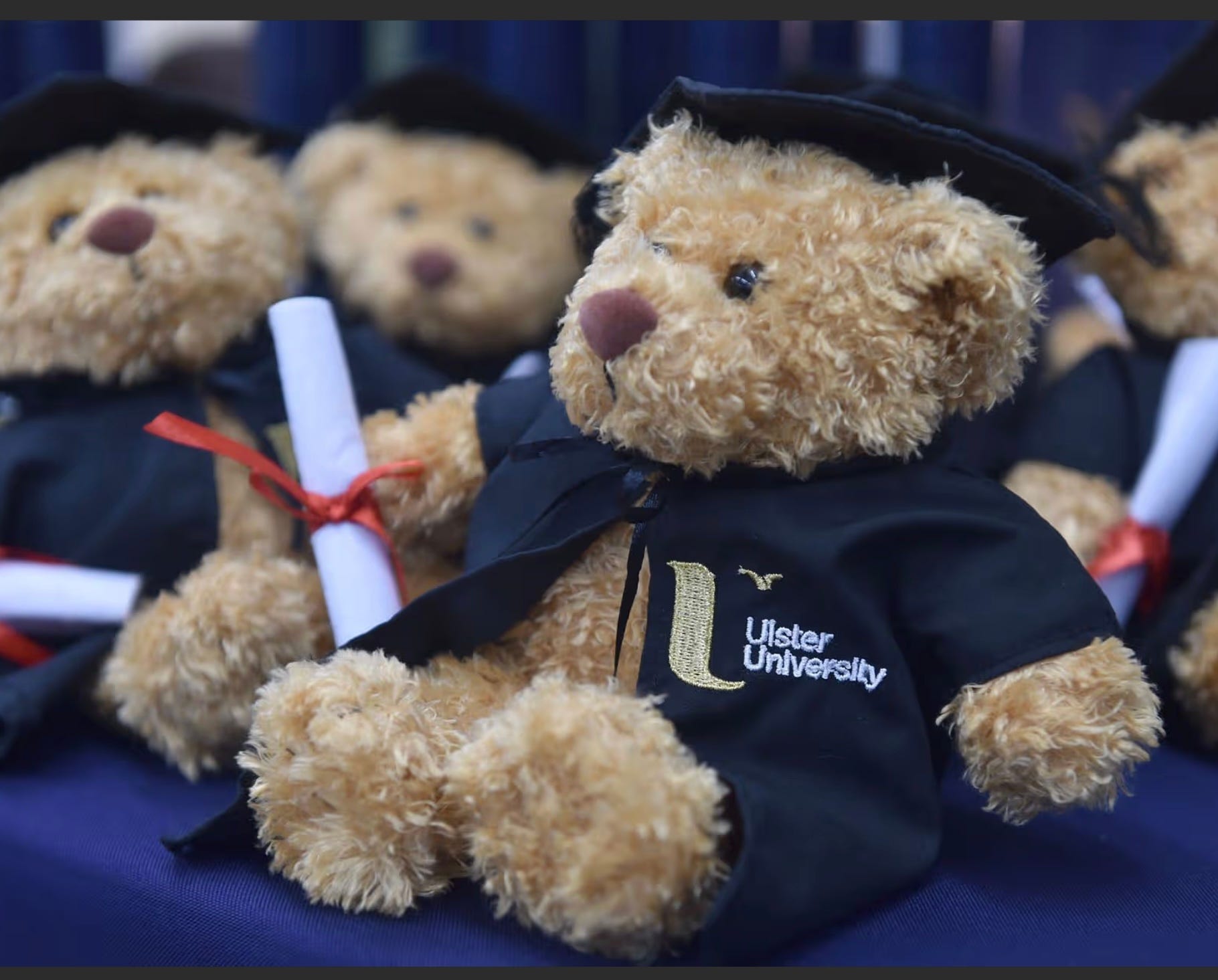
I was also dangerously tempted by the Ulster University merchandise shop which I had passed when navigating my way to the hall. Not the hoodies. The teddy bear. There was a small Ulster University teddy bear wearing its own little graduation gown, and for one brief moment I genuinely considered buying it. Thankfully, I retained just enough dignity to walk away. Because I suspect arriving home wearing the pin, carrying my degree and clutching a graduation teddy bear might have prompted my children to organise a gentle intervention, or at the very least book me in for an assessment.
The pin, however, is non-negotiable. That little thing is coming with me.
I pinned it onto my lapel, clutched my degree folder just a little tighter than was strictly necessary and made my way back to my seat. The ceremony continued.
Row after row. Name after name. Story after story. Each person crossing the stage carrying years of work that nobody else in the room could fully know. Then, eventually, it was over. Or so I thought.
The academics stood and processed back down the aisle, and we were told to follow behind them. I smiled to myself. Ah yes. The graduates respectfully following the grown-ups. Except that wasn’t what happened at all. When we reached the doors, the procession stopped. The academics split into two lines, one on either side, creating a corridor for us to walk through.And then they started applauding us. Yes. Us.
It completely caught me off guard. These were people who had devoted their lives to scholarship. Professors. Researchers. Lecturers. People who had spent decades asking difficult questions, marking impossible essays and gently dismantling arguments that students thought were watertight. And there they were, applauding us. I gave myself one very clear instruction.
Smile. My body had another plan. Cry.
So I found myself trying desperately to look like one of the younger graduates whose forehead is still being held up by collagen rather than Botox, while the still movable muscles in my face were negotiating the enormous lump in my throat. The expression I eventually managed probably suggested someone experiencing mild food poisoning. If anyone had asked, I’d have blamed hay fever.
There are moments in life that arrive without warning and quietly rearrange something inside you. That was one of mine. People have congratulated me on graduating. They’re very kind. But if I’m honest, the degree itself isn’t what has stayed with me. It’s what the degree represents. When I started this MSc, I thought I was going back to university to learn psychology. I did.
I learned about cognitive biases, about qualitative interviews and quantitative research, about evidence, statistics and the wonderfully humbling experience of discovering that the more you know, the more you realise you don’t know. But somewhere along the way, something else happened. I remembered what learning feels like when it isn’t tied to performance. When it isn’t about getting ahead. When it isn’t another box to tick or another qualification to collect. I remembered the joy of being fascinated. Of reading something that changes your mind. Of discovering that the answer you were hoping for isn’t supported by the evidence, and finding that strangely exciting rather than disappointing.
Perhaps that’s one of the greatest gifts of education. Not certainty. Humility.
The confidence to say, “I don’t know.” And then the curiosity to find out. It’s a lesson that feels particularly important now. We’re living through extraordinary times.
Artificial intelligence can write convincing paragraphs, summarise books, answer questions in seconds and often produce something that looks remarkably like expertise. But genuine learning has never been about collecting answers. It’s about developing judgement. It’s about knowing which questions to ask. It’s about recognising weak evidence, changing your mind when stronger evidence appears and becoming just a little less certain of your own certainty. That’s harder. And infinitely more valuable.
People sometimes ask me whether going back to university at sixty-one was worth it.
Financially? Probably not. Practically? Almost certainly not. Personally? Without question. Because somewhere between the lectures, the assignments, the statistics that occasionally made me question my life choices and the endless journal articles, I rediscovered something I hadn’t realised I’d misplaced.
Wonder.
Yes, people keep congratulating me on finishing my MSc. But that’s the funny thing. I don’t feel as though I’ve finished anything. If anything, I feel as though I’ve just been given permission to remain gloriously unfinished. And perhaps that’s what universities have always been trying to teach us.
Not that we should have all the answers. But that we should never lose the appetite for asking better questions.
The first person I met that morning thought I was staff. By the end of the day, I realised she wasn’t entirely wrong. Not because I belong on the payroll. But because I hope, for the rest of my life, I keep finding reasons to wander back into places where people gather simply to learn. Even if I occasionally need help finding the entrance.
Enjoyed this? Get the next edition.
Subscribe and I’ll email you a link each time a new edition is published.